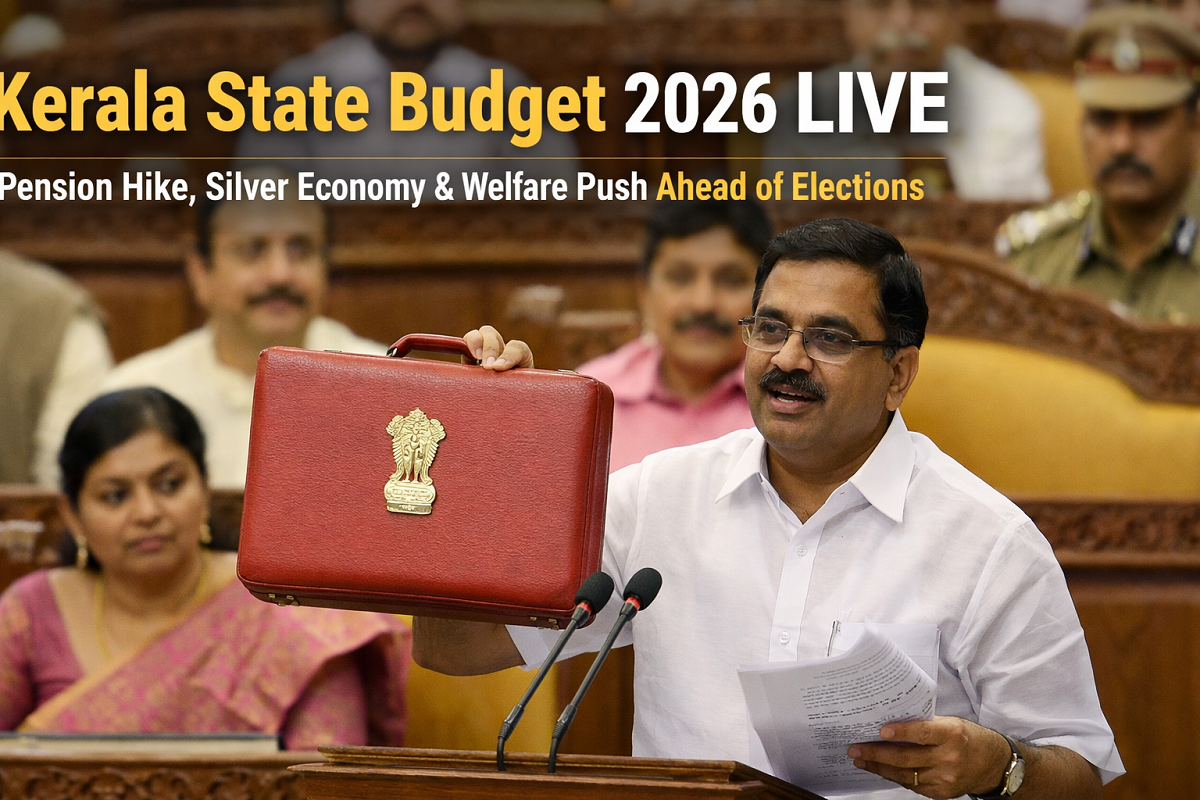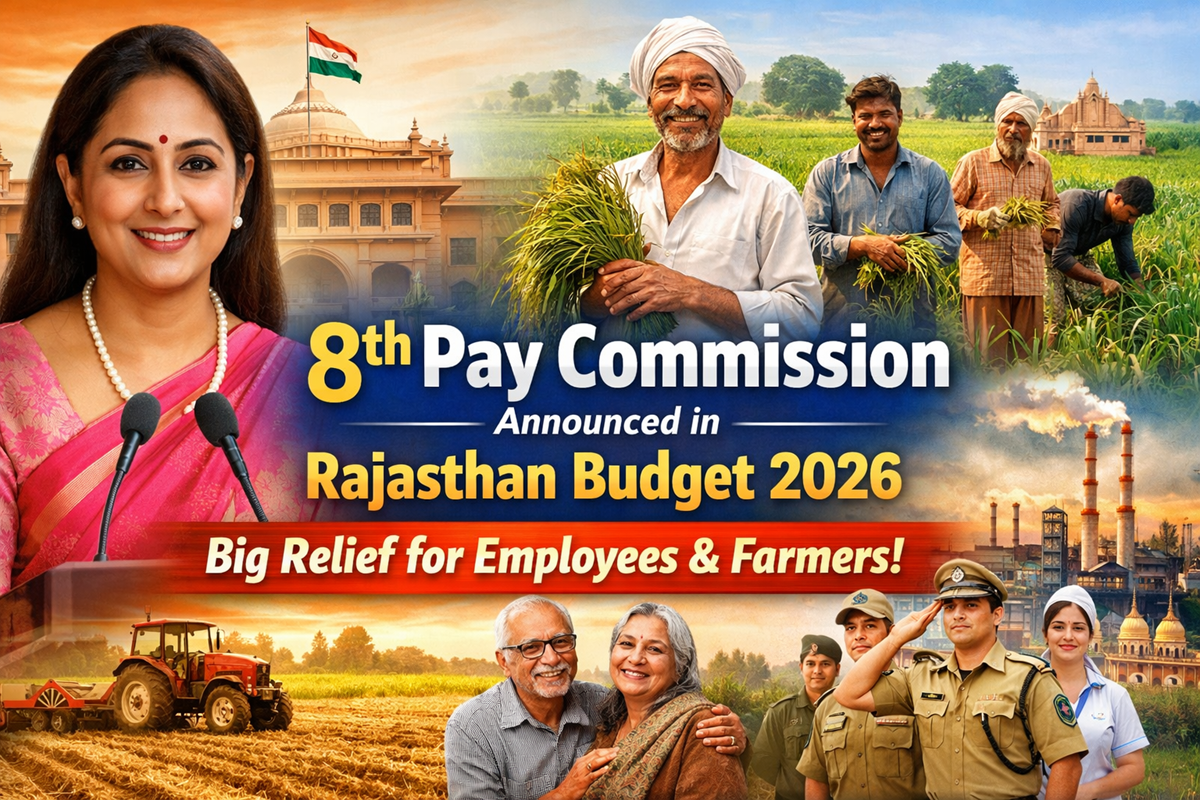
The Rajasthan Budget 2026, presented by Finance Minister Diya Kumari on February 11, 2026, has brought a wave of optimism for over 7 lakh state government employees and 4 lakh pensioners. The headline announcement—the formation of a High-Power Committee for the 8th Pay Commission—marks the official beginning of the salary revision process in the state.
This article provides a comprehensive breakdown of the 8th Pay Commission’s status in Rajasthan, how it affects your salary, and a simplified 8th Pay Salary Calculator to estimate your new pay.
Rajasthan Budget 2026: Key 8th Pay Commission Highlights
In a significant move to boost the morale of the state workforce, the Rajasthan government has officially initiated the process for the 8th Pay Commission. Here are the core details from the budget:
- High-Power Committee: The government will constitute a specialized committee to study the pay structure, allowances, and pension benefits for state employees.
- Implementation Date: While the central 8th Pay Commission’s reference date is January 1, 2026, the Rajasthan state committee will decide the final timeline and fitment factor for state cadres.
- Retrospective Benefits: History suggests that even if the notification is delayed, the benefits are likely to be given retrospectively from January 2026 in the form of salary arrears.
8th Pay Salary Calculator: Estimate Your New Pay
While the official fitment factor is yet to be finalized, experts and employee unions are projecting a factor between 2.28 and 2.86. Use the formula below to calculate your estimated gross salary.
The Formula
$$\text{Revised Basic Pay} = \text{Current Basic Pay (7th CPC)} \times \text{Fitment Factor}$$
$$\text{Gross Salary} = \text{Revised Basic Pay} + \text{DA (0% initially)} + \text{HRA} + \text{TA}$$
Projected Pay Matrix Comparison Table
The following table illustrates the potential jump in salary based on an expected Fitment Factor of 2.28 (Conservative Estimate):
| Pay Level | 7th CPC Basic Pay (₹) | Estimated 8th CPC Basic Pay (₹) | Estimated Increase (Approx) |
| Level 1 | 18,000 | 41,040 | ₹23,040 |
| Level 5 | 29,200 | 66,576 | ₹37,376 |
| Level 10 | 56,100 | 1,27,908 | ₹71,808 |
| Level 12 | 78,800 | 1,79,664 | ₹1,00,864 |
| Level 14 | 1,44,200 | 3,28,776 | ₹1,84,576 |
Note: The Dearness Allowance (DA) is typically reset to 0% at the time of a new Pay Commission implementation because the existing DA is merged into the basic pay.
Impact on Allowances and Pensions
The 8th Pay Commission doesn’t just increase basic pay; it triggers a domino effect on all other components:
- HRA (House Rent Allowance): Will be recalculated based on the new basic pay. Depending on the city category (X, Y, Z), this will see a substantial jump.
- Pensioners: Rajasthan’s 4 lakh pensioners will see their basic pension multiplied by the fitment factor. The minimum pension is expected to rise from ₹9,000 to approximately ₹20,500.
- Arrears: Since the implementation date is technically Jan 1, 2026, and the committee may take months to submit its report, employees can expect a significant lump-sum arrear payment in late 2026 or 2027.
8th Pay Commission: What It Means for Rajasthan Employees
The announcement of the 8th Pay Commission has created excitement among government employees across Rajasthan.
Key Highlights:
- Proposal to constitute the 8th Pay Commission committee
- Expected revision of pay scales and allowances
- Benefits for government employees and pensioners
- Implementation timeline to be announced after committee recommendations
If implemented effectively, this move could significantly increase salaries, improve pension structures, and boost employee morale across departments including education, police, health, and administrative services.
Experts believe the pay revision may also increase consumer spending in the state, positively impacting the local economy.
Big Relief for Farmers: Agriculture & Irrigation Focus
Agriculture remained one of the central pillars of Rajasthan Budget 2026. The Deputy CM emphasized:
- Expansion of irrigation projects
- Financial support for small and marginal farmers
- Subsidy schemes for modern farming equipment
- Focus on water conservation projects
New irrigation projects are expected to benefit drought-prone districts, improving crop productivity and farmer income. Special allocations have also been made for micro-irrigation and drip irrigation systems.